
Subscribe to continue reading
Subscribe to get access to the rest of this post and other subscriber-only content.
Writer | Marketing Partner
Subscribe to get access to the rest of this post and other subscriber-only content.
It’s the 4th quarter, and I can’t stand to waste time.
So my pain is your gain, and I am giving away marketing advice.
Learn from my mistakes during 18 years in business self employed as a writer and advisor to hundreds of leaders.
Start now – just takes your time to download and read 10 pages.
If you want help and don’t have $11, reach out and I will gift you the bundle.
Business Owners, especially local business owners:
Are you 10/10 confident your marketing plan aligns with your business goals?
I’m working on some marketing how-to guides based on my 18 years in business, so get it for FREE while you can. After October 31 it will be part of a paid bundle.
Get it here: https://karilen.gumroad.com/l/Q4marketingplays
Or subscribe if you’d like to be the first to see my next products.
Recently, I heard someone mention that they were working on getting their inbox to zero. If you are new to this concept, you may be used to leaving messages in and even using the inbox as a pseudo-to-do list. This is not processing email, and I am guilty of this myself. But I immediately thought of ways to focus on getting to inbox zero.
Some of us might need more time to get a handle on our email if we have been letting it pile up. We might need to declare email bankruptcy or start over. Even so, this article on how to get to inbox zero may help.
When considering the habit or goal of inbox zero, consider how achievable it is based on the current situation.
It can be a good idea to ask when is a realistic timeframe to achieve this goal? Am I aiming for today, this week, or the end of the month? Is this practice new, something I have done before, or something I am already doing (even if not perfectly)?
If there are thousands of emails or I don’t have the flexibility to dedicate more time to the task than I currently am, then it doesn’t make sense to try to get to inbox zero today (or probably this week). That’s okay. Time spent preparing and working toward a goal can be helpful too, even if it is to get a handle on how to make the goal happen.
For both veteran GTD-ers and newbies, it is worth stepping back for a few minutes, making a plan, and reviewing some good practices.
Make time for the change on the calendar. How much and when, you ask?
If this is to make a change or get back on the inbox zero wagon, then consider putting some new time on your calendar for email processing. Maybe start with 30 minutes a day for email, or two one-hour blocks to bookend the day.
If you feel like you need an empty inbox before you can set the priorities for the day or week, process emails on Monday morning and/or every morning.
It may feel better to have a sense of a clear inbox before leaving work for the day. Schedule a time block at the end of your day to process email. I like to do both. You could even set up three dedicated times to process email. The minimum time blocks I felt were sufficient were two sessions, but when there were full days of client delivery work, sometimes that did not happen every day. I’ve heard of people doing one. I can also see checking email more than twice a day, especially if disciplined with processing.
Try out an email processing schedule, and adjust based on how it is going and how you are feeling about your productivity.
What is processing? Think of it like blocking and tackling.
Processing is sorting. Getting to inbox zero means focusing on the habit of processing, which is another way of saying figuring out what to do with this email.
Again, for those familiar with Getting Things Done (or GTD) processing — now called clarifying — this may be old hat.
How to process email:
During the calendar block, turn off notifications, close your door or browser tabs, and stay focused on the task of processing email.
If you are relatively up to date, then start with the oldest emails first.
Read the email.
Then do, decide, or delegate. To deal with the email, respond to it, archive it, or schedule time to deal with it.
Be disciplined by staying on task.
Options for what to do after reading an email:
Delete it.
Accept a calendar invite.
Write a quick response and archive the email.
Write a quick response and set aside time on the calendar for further processing or doing the work.
Do not spend all your email processing time figuring out what to do with one email or actually doing work.
To help with this, use the two-minute rule.
Take up to two minutes to review and handle one email.
If an email requires work, decisions, or more than two minutes for any reason, move on — by setting aside time or adding something to the to-do list.
If you spend the entire email time handling one email, this will work against you. Also, you may need to think about a response, design something, or review something. So, put this in another inbox or on your task list or calendar. Don’t spend the entire time doing one email…unless you decide that is more important than inbox zero.
Two-minute responses are shorter than you might think. Typing more than a sentence or two will lead to items staying in your inbox.
If you find you need a lengthy back and forth, is it possible to let the person know you will review the email, and ask could they get on a call to talk? Similarly, if you have five emails from the same person who really needs a conversation, file them into a folder and set up a call.
Here is a bonus idea for extra support. Let colleagues know that you are working on getting and staying current with your inbox. Then, when you send brief replies or don’t reply to something not requiring a response, they will know you are working toward your goal and not just ignoring them or being short. Letting others know your priorities can help achieve them and add context to interactions.
I still am sitting with disbelief in some moments about Tony Hsieh dying. Saturday morning I got a text message with a news article saying he had died while visiting family. The stories and tributes from admiring fans and loved ones flood the internet, full of articulate and heartfelt memories and appreciation. It was and is unbelievable. I keep hoping I will wake up and figure it out somehow, and find myself back in Tony’s presence spontaneously dancing or doing whatever antics he’d bring. Even with his name in the subject of the Forbes email in my inbox today, a part of me wonders at times when and if I will wake up from this nightmare. I can’t help it. I guess denial is part of grief, so it makes sense.
The nightmare is that a larger than life friend to many has been abruptly taken by death in a tragic accident. Death is easier to accept and cope with when it is abstract. Then when it hits close to home, it takes our life, plans, and sense of reality and changes it. This has felt like a punch in the throat/heart/stomach.
Many others have been closer to Tony for longer. He was a friend to me. I met him when Zappos and Downtown Project were clients. We hit it off pretty quickly.
Nervous to facilitate the chief executive of our key client, I was trying my best and outside of my comfort zone, learning about startups, fashion, and more about business in general. Early on Tony invited and tried to convince me to move to Vegas. I did not have a good excuse and he spread rumors that I was moving and brought it up in meetings to talk about it and put me on the spot. He was unrelenting when he had a vision.
A bit later in our friendship I might text him how you doing or thinking of you. Come to Vegas he would say. Or when are you coming to Fergusons? I would think about when I could make the next trip…and why I was not there now. His efforts at including me in outings, connecting with new people, and family style meals were consistent, as I would visit and connect with old friends from prior visits and other visitors in my temporary cohort. I would often extend my trip. I took time off and didn’t know what to do and he told me Come to Vegas. I did. I was so glad.
There were animals and often a family atmosphere. We would walk around and check in and say hi to people and the chickens or Marley or whatever in the time available. Even if Tony wasn’t around I would spend time with his friends, whoever else was around, and of course Marley and Blizzy. Tony was so warm and concerned with people’s needs and well-being. I saw him always feeding people, and often making soup. I would text him after I landed and was on the way to the trailer park or before that to his apartment. There is soup. Or pizza’s here. Help yourself he would say.
One time I had a migraine and he picked me up with his bus and asked if I needed anything so I could come to the Zappos company party. I was going to stay in my trailer and rest. He convinced me I could rest and hydrate on the bus, and I got dressed and went. A group of people was on the bus as this happened.
The last exchange we really had was typical Tony, wondering how I was doing and trying to help. It started from an accidental group text from him to his house keeper, so I had to respond and then we got into a conversation. Tell me your passions work and non work and I will brainstorm ways we can work together, he texted. We hadn’t spoken in more than a year, but that did not matter. He was ever supportive. I worked on the passions and sent them to him.
When we weren’t playing around or connecting, it felt like we were debating. I learned to understand this is how he loved. This is how he cared. It hurts so much to think that we won’t be together again in this life. No more texts instructing me to come to a place at a time not knowing anything else or late night jams or llama bus cigarettes. It feels overwhelming and impossible to articulate what his life and friendship meant even if I had not visited him for a while. He will always be an unlikely and special friend. A complete surprise. May his spirit live on in the best possible way.
I am continuing to remember and celebrate Tony, and learn from our short dance together. Here are a few things which he taught me.
So grateful to have had the honor. Rest in peace friend.
Do or do not. There is no try.
-Yoda, Star Wars: The Empire Strikes Back
Many people recognize this quote from Yoda when he speaks to Luke as his ship sinks in a swamp. What do you think and feel about the well-known Yoda quote?
Though beloved by many, Yoda is only a fictional character. We still have to think, pray, and decide for ourselves. It may not be obvious at times what is ours to try on and what is not.
For a long time, I have thought about this movie quote. I find it easy to misuse the advice, so it isn’t always supportive. In fact, it may rarely be supportive. Let me explain…
The first time I remember seeing and thinking about the quote was in my 9th grade Government class. Our wonderfully engaging teacher, Mr. Croft, wrote it on the board before class. I don’t remember why he wrote it there. I remember a heated (for 14-year-olds) discussion on it. For years I thought of the one-liner as a motivational statement. The saying feels similar to Just do it! On the surface, it seems good. The quote, like listening to Eye of the Tiger, helped me get my head in the game.
20 years or so ago, the saying started to bother me, and then even more in recent years as I came to value God and other ‘things’ like presence and being more, it just didn’t resonate. Similarly, what I learned about neural pathways did not add up with this advice. Now I also live in a regular state of mystery, often not knowing what I will or won’t do until it happens. The quote doesn’t apply much of the time.
For Yoda and Luke, there was an immediate situation that needed action, and waiting meant failure. There was no time for trying, learning, and failing.
Emergencies or life and death situations, like what first responders regularly encounter, or other urgent situations call for this advice. Sometimes we only get one shot. We have to give it our all. I realize that sometimes we only get that one shot, so we need to put our whole heart and self into it. Waiting means we miss the chance to act, and the moment passes us by.
For the most part, trying and learning enriches us and those around us. Trying requires some openness to failure and ambiguity. Ideally, we are trying things and learning when it is not an emergency.
This year I started drawing to pass the time in a quiet way when the coronavirus took over our schedules and I was quite lonely. I had no idea if it would work since at almost 40 years old I have never really drawn, much less how well it would work.
Don’t get me wrong; learning is not always easy and fun. Sometimes it is necessary though. Sometimes we unlearn, relearn, or start over in life and learn something new. What else are we here for?
I stand for learning. I like trying. I also support not doing and not trying if that is best for someone.
If I only did what I knew I could absolutely do, and there was no option for imperfectly trying, I would not even write this post.
I would not have pursued my last career or attempted many of the things in my life, which have all led to knowing amazing individuals. When I am in a spirit to just try rather than do versus do not, life feels better for me.
Besides, neuroscience research on the brain and learning grows all the time. It teaches us that we can change and learn, and this depends on neural pathways. So there is no do or do not. We try! And with support come the neural pathways and learning or changing.
We don’t know what is happening or what will come. So we have to try. In fact, some of the answers are not found in doing at all.
How can we rise to challenges, despite this not knowing?
How can we be creative in our lives?
What is our work at a given time in our life?
So how about it?
Do you try, or only do or do not?
Do you try to be a kind person?
Even trying to do some things (like be a good person) can make a big difference.
I want to say again, I am for trying. I am for accepting failures as part of life. I am for learning.

I posted this on Facebook and thought it worth publishing here. Dr Mate creates a useful way of viewing addiction that I think is applicable to everyone.
https://www.bbc.co.uk/ideas/videos/addiction-is-a-response-to-emotional-pain/p07tnh6m
Great to see Dr Mate shared on BBC. “We are all just like the rest of us.”
Addicts are always traumatized, he says. Addiction is any behavior that offers short term relief or pleasure and also has negative consequences of some kind, yet one cannot or does not stop. Myths of addiction are genes pre-determine we become addicted and addiction is a choice. With this definition of addiction, it normalizes the process of suffering…and healing.
I think no one is immune to this conflict of self harm to resolve pain, even if it is very temporary and more on the level of eating cookies every day for a few days to cope with emotional pain and feeling the effects of that, and then continuing to do it again the next day.
It is Monday morning. Many people are going to work or school. I have nothing scheduled this day (if you don’t count my walks with dogs and canine meal times which are sacred commitments so I guess I ought to count them). Having nothng scheduled is common for most of my days. It isn’t like an endless vacation though, any more or less than life with a Labrador generally is. At times I wonder if it is Friday or what day it is at all. Sometimes I feel some hurt at the difference in my world, and my past world and what feels like a majority of others’ worlds, as I am focusing on my health, basically professionally orphaned, in recovery from relational trauma, witnessing and focusing on being every day. I still have plenty of possibilities, and personal projects I could attend to, and stress. But I don’t have the pressure of a 9 to 5 or even the pressure and support of a global team and jet setting consultant schedule. I don’t have the regular hosting of clients, and admiration and requests of colleagues of various kinds.
People ask what I do.
It is not an easy question for me because there has been a lot of loss associated with this. To some I am unemployed. That is their paradigm. But I haven’t had a job-job for like 12 years. I can’t say I am a consultant or even a coach. It feels wrong to say I do nothing. I know it is contextual, but still…
What do I do? I write every day. I listen. I connect things. I create…create structure for my day. Become present. Focus on what matters. Discover my next life by living each moment breath by breath, step by step. I try to connect with people, encourage them, and share what is relevant. In general, be a helpful citizen. Go the speed limit. Let people merge. Hold the door. Be patient in line at the store. I walk my dog. I try to take care of our lives. Various activies and plans to help my physical and mental health. I help neighbors or friends when I can. I run with my dog daughter. I go to church. I meditate. I lead meditations or yoga with friends. I learn things. I follow up with people. I promote things, like the Responsive Conference, The Loop Approach, and hugs.
Why write? What is consistent? What is safe? What is empowering?
Writing is all of the above for me. I write to put out my disorganized thoughts, to shed light on the shadows or unseen thoughts of my mind, to rehash something that is still working through me. Mainly it is just a daily practice that I can do to add positive intention to my routine. Okay, I lied it is really a magical portal into as of yet uncreated realities.
What have I accomplished with this daily writing?
Why would I be so dedicated to do this thing every day with no goal and no measure of quality? Hint: it is because I want to, it is loving, it is about how being is a priority. It is a form of mindfulness practice because I witness, I give permission to be, to feel, with curiosity and compassion as I self express in writing.
Mostly I learn things about myself, though I believe it is a great help to our relationships, life goals, and work too, if we want it to be or need it to be. For these last 167 days or so it has been my only daily thing, aside from walking Liv the Lab.
What does the streak mean?
Why write?
Are you having a hard time? Are you sorting through something challenging or complex or emotional, even if you think it is positive? Are you desiring more intention in your day, self awareness, or pretty much anything? Want to build a habit? Then there is the obvious, which is do you want to write a book or maybe just write more?
The daily writing can help us clear our head, get distance with our thoughts, or just give ourselves space that no one else or nothing else will. I have probably said or written this before but we get to know our consciousness with this kind of unfiltered, private, regular writing. What is your daily mindfulness or other practice? What has it taught you? How are you getting to know your consciousness?
From there, I may brainstorm, craft communications, or make or edit lists. More on those in future posts.
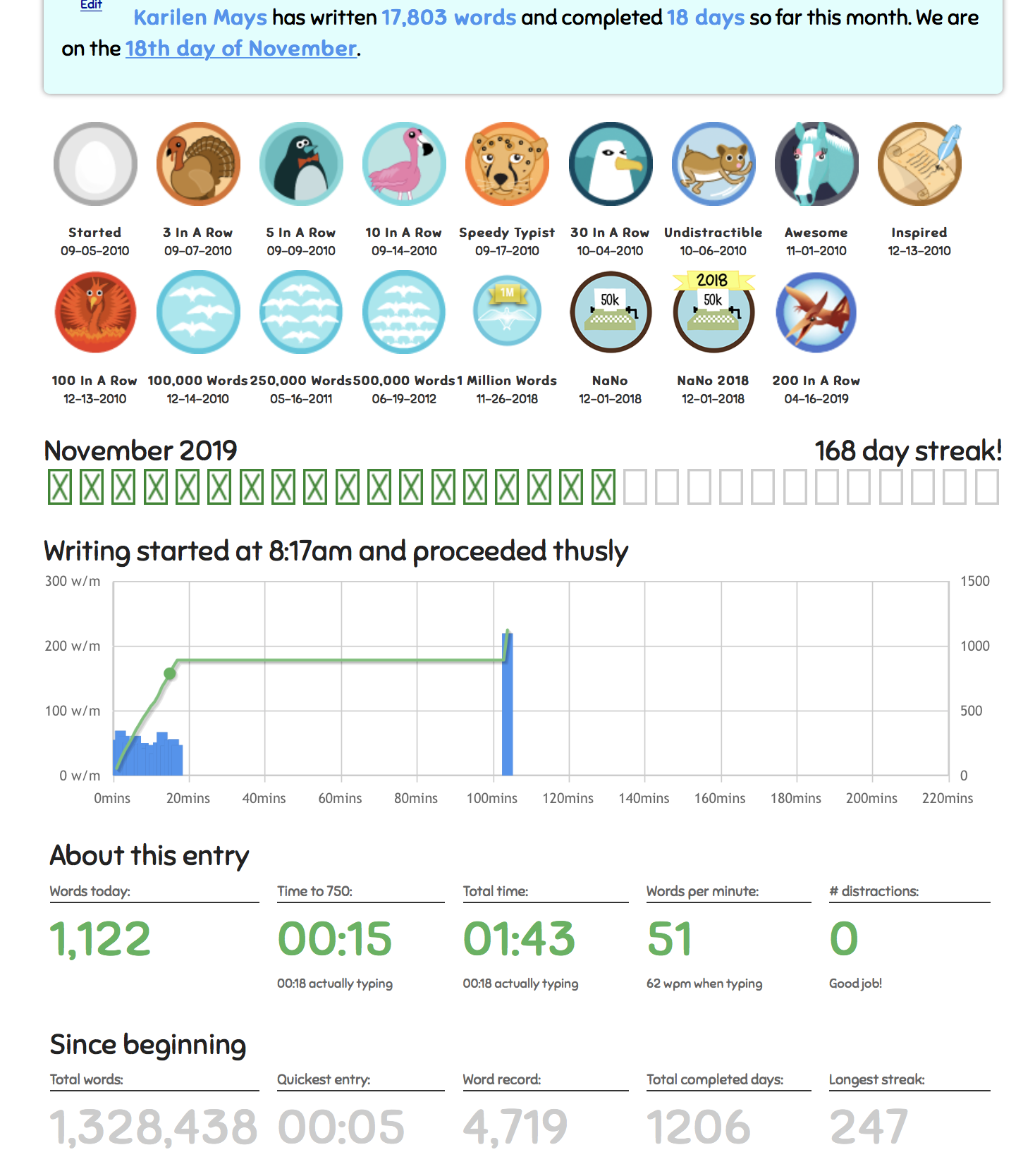
750words.com is a free website that helps you write every day. What I really think is that it is a safe and magic space of creation, for whatever you want. I rely on the daily emails from the site checking in about my progress.
Have you ever been like me and tended to over-commit or have times when your desires or appetite or life is far more challenging, conflicting, or complex than you can act on in a day? Is it just me? Whether I am fully loaded with work projects or not officially on a job, I have discovered this pattern remains for me. And maybe also like me, you make routines and practices to know yourself, your values, and your commitments. We meditate or exercise or consult with a friend or a divine presence to decide. Or we re-prioritize or act based on our health, financial needs, or the shiny requests and offers of others, of the world.
I often wake up and see and believe way more will happen in a day. It may be a migraine, or a lapse in planning and arrival of a deadline, or an opportunity or something unpredictable and not anyone’s direct influence like a broken car key, change in someone’s plan, or sudden flood that washes out the very road as you drive.
How many things do we commit to accomplish in a day? If you take our your dog, go to work or do something for someone else, make meals, do errands or other personal tasks, then that is a lot. Then there are those times when we get that call from a friend who needs something or needs to talk…but our day is all committed…then what?
If our days feel like they have a healthy amount of activity and balance of rest, fun, relationships, and whatever work is, then this may be a chance to get more creative. Or it may just provide a reflection on how much you are out there able to do, be, and contribute for yourself and others instead of literally doing one thing per day.
If our days feel tenuous and or overwhelming, then this could be an opportunity to hold ourselves more gently and with more space.
I believe in only doing one thing per day. This could be a phone call that is big, or reviewing a document, or a meeting, or a working session, or connecting with someone, or a decision.
Depending on the thing for the day, then I attempt to go ahead and get that call out of the way or submit the application for the thing, if I can clear it. Because if so, then after there is time for …Cookies!! (or some other celebration). And often the things we try to do turn into something else or a series of things, so starting early or scheduling it appropriately helps regardless of the outcome.
Or if it is a day-long thing or something that has to happen later, then I set up the rest of my day with intentional structure around it. If I am committing to having a meeting I know I may need a couple hours before and that means maybe I could rest, do something easy at home, or perhaps something more complex.
Sometimes we need to schedule that one thing. Or tell someone we need to do it or are going to do something about ________.
Doing one thing per day is a practice, though the phrase can be misleading since it can be that while we commit to one thing and allow for others, then. It can be challenging to say no or adjust commitments or plans around the thing of the day. This practice creates intentionality, helps us know ourselves, and constantly let’s us consider what is important, and allow for changes.
I don’t deprive myself of doing more things like scheduling other calls or making plans or whatever. But what is important is the focus and then other things are built around this one thing. Then there is intentional space, whatever comes.
That is the secret of this. By doing one thing at a time, once per day, then it holds space for yourself. And what comes from that can be doing many things. Or not.
Some years ago I worked with a friend who had a routine he called Start, Stop, Continue…and we would go through our projects and decide. I believe it came from some software team practice. At times I would take everything I would be doing or thinking of doing and run it through these filters.
Now at one point just with my work alone at HolacracyOne, my old company, I had like 3 dozen roles or so, and had more projects than I could manage. I used every tool I had and then some to chunk it down, focus, prioritize, outsource, manage expectations, protect my sanity, and more. Getting Things Done (GTD) has been a lifesaver for many reasons.
Most people, myself included have around 100 or so outcomes we are working toward at any given time. Only some of them are really clear and known to us. So we are often subconsciously working on all our stuff. By writing down our outcomes, our things to talk about with each other, and essentially tracking all the commitments we have made (to ourselves, since that is first and foremost what I commitment is) we can have headspace to be creative, be more reliable in our commitments, and even think more…about more projects, which are really anything from something like finally going on that trip with that special someone to publishing an article to starting a new career. It is just our life’s work, these projects. Work is simply a subset of our life.
Yet something happens when we then agree to get back to someone. Or have a conversation with someone and we both think we should again. Or we have a proposal out to a client and they aren’t responding. Or we have some challenges in our relationship or our work. We start seeing and feeling these open loops. These open loops are needing something. They need attention. They need a parking lot, a place holder. Or they keep wanting.
What happens when you can’t close an open loop? Sometimes a relationship has run its course. Sometimes our personal needs take us on a different path from our colleagues. Sometimes we simply don’t want to keep engaging in something that may not be worthy of our attention and effort, or worse, even harmful. Do we have to finish?
No more than we would be expected to clear our plate even if we are full should we need to finish something. Completing has become important. And that doesn’t always mean finishing. Sometimes it means pausing. Sometimes it is letting go. And sometimes it is leaving. If we can we can communicate something about this. I am not saying it is easy nor socially acceptable nor without cost to complete things in this way and not feel pressure to finish it in a prescribed way, within someone else’s terms, or at all. We find a way to complete or close these open loops for ourselves even if it is solely within ourselves and the rest of our lives. We needn’t actually ever go near the person, place, or thing that is an open-loop to complete it for ourselves.
 Karilen Mays
You must be logged in to post a comment.